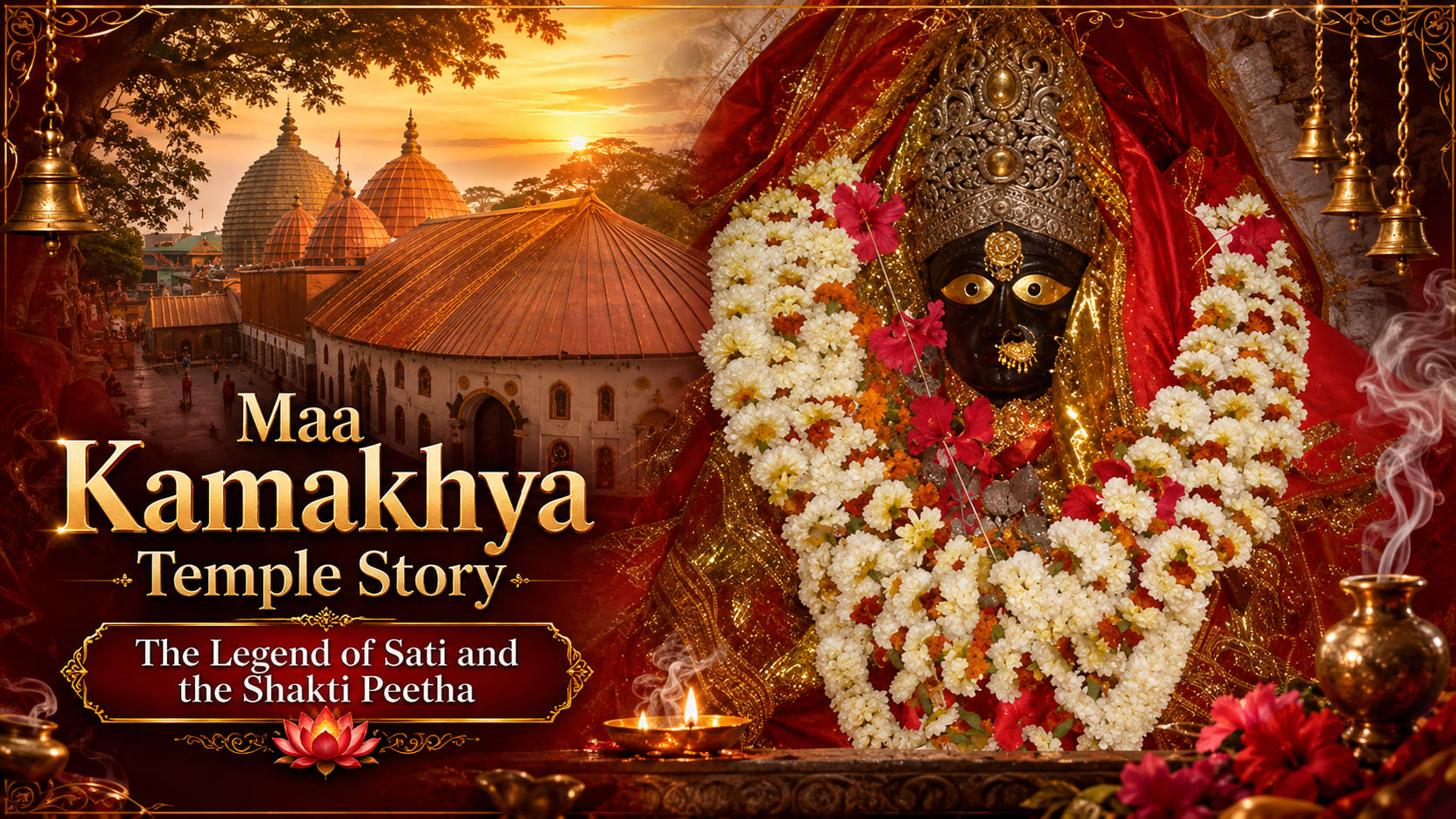
Maa Kamakhya Temple Story: The Legend of Sati and the Shakti Peetha
The Maa Kamakhya Temple in Guwahati, Assam, is one of the most powerful and revered Shakti Peethas in Sanatan Dharma. Its story begins with the tragedy of Goddess Sati and stretches across mythology, medieval history, and living tradition.
In simple terms, Kamakhya Temple is sacred because it marks the place where a part of Sati's body is believed to have fallen after her self-immolation and Lord Shiva's grief-stricken Tandava. This event, connected closely to the story of Shiva and Parvati's union, is considered the origin of all Shakti Peethas across the Indian subcontinent, and Kamakhya is regarded as the most important among them.
Key Highlights
- Kamakhya Temple on Nilachal Hill, Guwahati, marks the spot where Sati's womb and yoni are believed to have fallen
- There is no idol in the sanctum; devotees worship a natural yoni-shaped rock formation kept moist by an underground spring
- It is counted among the four Adi Shakti Peethas, alongside Kalighat, Tara Tarini and Bimala Devi
- The present temple was rebuilt between 1555 and 1565 CE by the Koch king Naranarayana and his brother Chilarai
- Its beehive-shaped brick shikhara belongs to the distinctive Nilachal style of Assam
- The name comes from a second legend, in which Kamadeva regained his form here — Kamakhya means 'the one who fulfils desire'
- The complex is a major Tantric centre, with shrines to all ten Dasa Mahavidyas
- The annual Ambubachi Mela marks the goddess's menstruation cycle, when the temple closes for three days
Significance of Kamakhya Temple in Sanatan Dharma

Kamakhya is not a temple in the usual sense. There is no idol here. Instead, devotees worship a natural yoni-shaped rock formation inside an underground sanctum, kept perpetually moist by a spring. This form of worship represents creation, fertility, and the life force of the divine feminine, known as Shakti.
The temple is considered the most powerful of the 51 Shakti Peethas because it enshrines the source of creation itself rather than a single limb or ornament. Devotees seeking blessings connected to fertility, courage, and the removal of obstacles often turn to Kamakhya, alongside other forms of the Divine Mother worshipped across India.
Among the 51 Shakti Peethas, tradition further recognises four as the Adi Shakti Peethas, the earliest and most powerful of the group: Kamakhya in Assam, Kalighat in Kolkata, Tara Tarini in Odisha, and Bimala Devi within the Jagannath Temple complex in Puri. Kamakhya's link to Kalighat is especially close, since both sites are central to Shakta worship in eastern India, a tradition also reflected in our coverage of Durga Puja celebrations in Bengal, where the same spirit of goddess worship takes on a festive, community form.
The Legend of Sati: How the Story Begins
To understand Kamakhya, it helps to go back to the story of Sati, the daughter of King Daksha and the first consort of Lord Shiva. Daksha never approved of his daughter's marriage to Shiva, whom he saw as an unconventional ascetic rather than a suitable king's son-in-law.
Daksha's Yagna and the Insult to Shiva
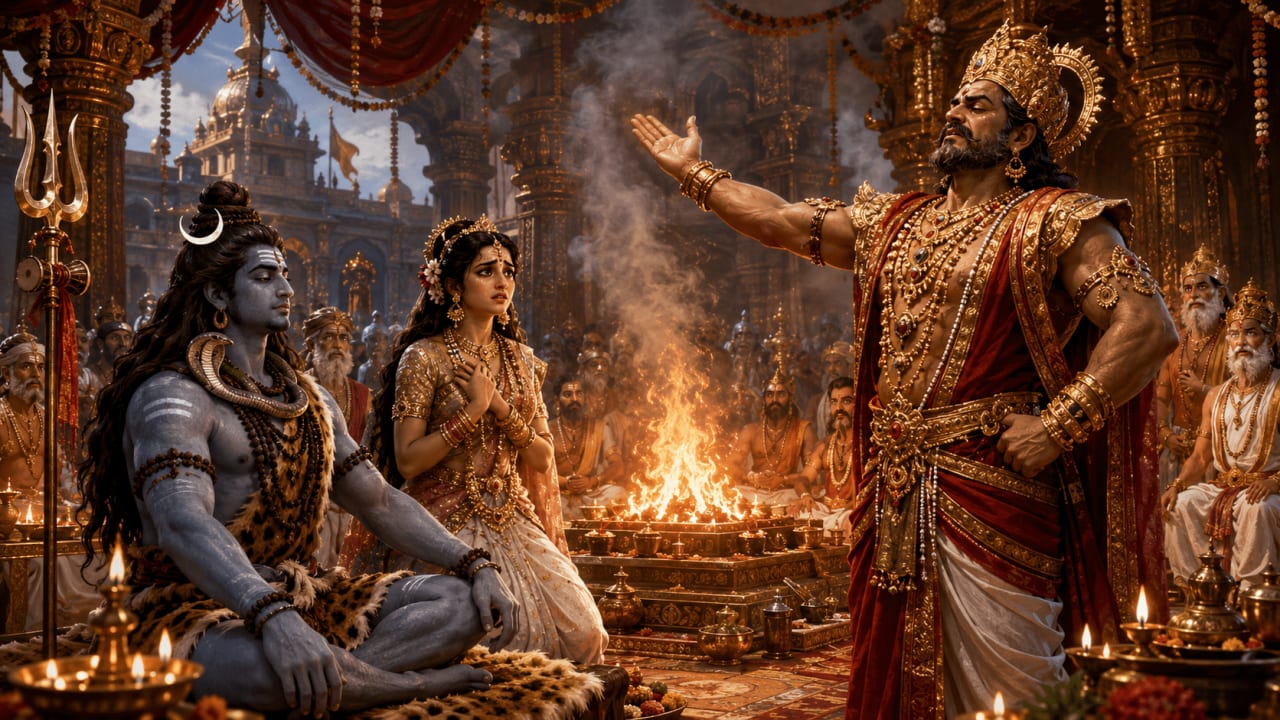
Daksha once organised a grand yagna, a sacred fire ritual, and invited every god and sage except Shiva and Sati. When Sati learned of this, she insisted on attending despite Shiva's warning that she would not be welcomed. At the yagna, Daksha publicly insulted Shiva in front of the assembled gods and sages.
Unable to bear the humiliation of her husband, Sati gave up her life in the sacrificial fire. Some versions of the story describe this as an act of yogic self-immolation, while others describe her invoking her own divine energy to end her mortal form. Across scriptures, the emotional core of the story stays the same: Sati's devotion to Shiva was absolute, and Daksha's insult broke something that could not be repaired.
Shiva's Grief and the Tandava
When Shiva learned what had happened, his sorrow turned into a fury that threatened the balance of the universe. He lifted Sati's lifeless body onto his shoulders and began the Tandava, his cosmic dance of destruction, wandering the three worlds in inconsolable grief.
The gods, fearing that Shiva's grief would destroy creation itself, appealed to Lord Vishnu for help. This episode is often read alongside other stories of divine intervention to restore cosmic balance, similar in spirit to accounts like the battle between Durga and Mahishasura, where the gods again turn to a higher power when the universe is at risk.
The Birth of the 51 Shakti Peethas

To calm Shiva and stop him from carrying Sati's body across the universe, Lord Vishnu used his Sudarshan Chakra to gently cut her body into pieces as Shiva danced. As each part touched the earth, that place transformed into a Shakti Peetha, a seat of the goddess's power.
Traditional texts count 51 such sites spread across the Indian subcontinent, each associated with a different body part of the goddess and worshipped under a distinct name and form. Our dedicated guide on the 51 Shakti Peethas and the divine feminine covers the full list and explains how these sites are connected in one unbroken tradition of Shakti worship.
Where Kamakhya Fits in the Story
At Kamakhya, tradition holds that Sati's womb and yoni fell on Nilachal Hill in present-day Guwahati. Because this body part represents the source of creation and fertility, Kamakhya is regarded as the most powerful of all the Shakti Peethas. The Kalika Purana, an ancient text associated with the region, describes this site as the Yonimandala, the sacred abode of the divine womb.
This is also why Kamakhya does not have a conventional idol. The sanctum houses a natural cleft in the rock, shaped like a yoni and continually moistened by an underground spring, and this formation itself is worshipped as the goddess.
Kamakhya Among the Major Shakti Peethas
Every Shakti Peetha is sacred, but a handful stand out for their scale, antiquity, and the body part of Sati they are believed to enshrine. Here is how Kamakhya compares with a few other well-known Shakti Peethas across India.
| Shakti Peetha | Location | Body Part (Belief) | Presiding Goddess |
|---|---|---|---|
| Kamakhya | Guwahati, Assam | Womb / Yoni | Kamakhya Devi |
| Kalighat | Kolkata, West Bengal | Toes | Kali |
| Jwalamukhi | Kangra, Himachal Pradesh | Tongue | Jwalamukhi Devi |
| Kanchi Kamakshi | Kanchipuram, Tamil Nadu | Backbone | Kamakshi Devi |
History and Architecture of Kamakhya Temple
Beyond mythology, Kamakhya has a long and layered history. Some accounts suggest a temple existed on Nilachal Hill as early as the 8th century, with references to the site appearing in texts such as the Kalika Purana and Yogini Tantra. Over the centuries, the original structure was damaged, possibly by invasion or natural causes, and its upper portion remained in ruins for a long period.
The temple as it stands today largely dates to the 16th century. The Koch king Naranarayana, along with his brother Chilarai, rebuilt the temple between 1555 and 1565 CE. Their architect attempted to recreate the original stone dome twice and failed, eventually building the current beehive-shaped shikhara using brick instead. This gave Kamakhya its distinctive rounded tower, quite different from the tall spires seen at most North Indian temples.
In the following centuries, the Ahom kings, who ruled Assam for a long period, expanded the temple complex further. Ahom king Rajeswar Singha is credited with adding the Natamandira, a hall used for ritual music and dance. The temple follows what is known as the Nilachal style, a regional architectural tradition unique to Assam. Readers interested in how Hindu temple architecture varies across India can explore our guide to temple sculpture traditions for more context on regional styles and symbolism.
The temple complex today includes shrines to the ten Mahavidyas, various forms of Shiva, and other deities, making Kamakhya not a single temple but a living complex of Shakta worship built up over many centuries. Readers interested in how such complexes evolve architecturally across India can also see our broader guide to temple architecture of India, which places Kamakhya's Nilachal style in a wider national context.
Why Is It Called Kamakhya? The Legend of Kamadeva
The name Kamakhya has its own story, separate from the tale of Sati, and it explains the temple's deep association with desire, love, and restoration. According to this legend, Kamadeva, the god of love, once angered Lord Shiva by disturbing his deep meditation. In his fury, Shiva opened his third eye and reduced Kamadeva to ashes.
Rati, Kamadeva's wife, was heartbroken and pleaded with Shiva to restore her husband. Shiva agreed, but Kamadeva lost his physical form and radiant beauty in the process. On Shiva's advice, Kamadeva performed penance atop Nilachal Hill, and it was here that the goddess blessed him and restored his grace. In gratitude, Kamadeva is said to have built a temple for the goddess at this very spot, and the site came to be known as Kamakhya, meaning 'the one who fulfils desire.' This story runs alongside the Sati legend rather than replacing it, and both are told together as part of the temple's living oral tradition.
Kamakhya and the Tantric Tradition
Kamakhya is regarded as one of the most important centres of Tantric worship in India. The temple complex includes shrines to the Dasa Mahavidya, the ten wisdom goddesses, including forms such as Kali, Tara, Tripura Sundari, Bhuvaneshwari, Chinnamasta, Bhairavi, Dhumavati, Bagalamukhi, Matangi, and Kamala. Each Mahavidya represents a different aspect of divine feminine power, from fierce protection to deep wisdom and abundance.
This tradition draws sadhus, scholars, and spiritual seekers from across India who come to study and practise Tantric worship at the site. Readers who wish to understand more about these fierce forms of the goddess can read our profile of Goddess Kali, one of the most significant Mahavidyas associated with Kamakhya's tradition, and our guide to Durga mantras for courage and protection for those wanting to understand Shakta chanting practices in a simple, accessible way.
Kamakhya's Place in Assam's Cultural and Spiritual Life
Beyond its religious importance, Kamakhya sits at the heart of Assam's cultural identity. Nilachal Hill is not just a pilgrimage site but a landmark that shapes Guwahati's civic and spiritual rhythm, drawing visitors, researchers, and artists throughout the year.
The temple's calendar of rituals runs alongside Assam's other major regional celebrations, and understanding one helps make sense of the other. Our article on Bihu, Assam's traditional harvest festival, offers useful context for readers who want to see how goddess worship at Kamakhya fits within the broader devotional life of the state.
The Ambubachi Mela: Kamakhya's Most Important Festival

Every year, usually during the monsoon month of Ashadha, Kamakhya hosts the Ambubachi Mela, one of the most distinctive festivals in Hindu tradition. It marks the annual menstruation cycle of the goddess, a period during which the temple doors close for three days as the earth itself is considered to be in a state of rest.
When the temple reopens, devotees receive prasad believed to carry the goddess's blessings of fertility and creative power. Lakhs of pilgrims, sadhus, and Tantric practitioners travel to Assam for this occasion, making it one of the most crowded and spiritually charged times of the year to visit Nilachal Hill.
Because exact Ambubachi Mela dates follow the traditional calendar and shift each year, devotees are advised to check the DevMarg Hindu calendar closer to the date of travel for confirmed timings. The month itself is covered in more detail in our Ashadha 2026 vrat calendar.
Planning Your Visit: A Simple Guide
Kamakhya Temple sits on Nilachal Hill, about 8 kilometres from central Guwahati, and is well connected by road, rail, and air. Here is a simple guide for first-time visitors.
- Reach Guwahati: The city has its own airport and railway station, both well connected to major Indian cities.
- Travel to Nilachal Hill: Local taxis and auto-rickshaws are available from the city, and the temple has its own parking area.
- Plan for queues: Kamakhya sees heavy footfall, especially during Ambubachi Mela and on Tuesdays and Sundays, so early morning visits are usually smoother.
- Dress modestly: As with most Shakti temples, simple and modest clothing is recommended for darshan.
- Photography restrictions: The inner sanctum does not permit photography out of respect for the sanctity of the site.
Since customs can vary slightly from temple to temple, it is worth reading our general guide on temple etiquette, dos and don'ts before your visit, especially if this is your first time at a Shakti Peetha. It also helps to understand the meaning behind common temple rituals, covered in our article on the sacred science behind temple bells, so the darshan experience feels familiar rather than unfamiliar.
Once inside, most devotees also perform a slow walk around the sanctum and join in the evening aarti, two customs you will see repeated throughout the Kamakhya complex.
Editor's note: Practices at Kamakhya vary across sampradayas, individual family traditions, and the temple's own ritual calendar. This article covers the commonly told legends and widely followed customs. For guidance on a specific ritual or a planned visit during Ambubachi Mela, please consult the temple administration or a local priest.
Frequently Asked Questions
What is the story behind Kamakhya Temple? Kamakhya Temple is linked to the story of Sati, who ended her life after her father Daksha insulted her husband, Lord Shiva. When Lord Vishnu divided Sati's body to calm Shiva's grief, her womb is believed to have fallen at Nilachal Hill, making it one of the 51 Shakti Peethas.
Why is Kamakhya considered the most powerful Shakti Peetha? Kamakhya is associated with the goddess's womb and creative power, which many traditions consider the source of all life. This is why it holds a uniquely high status among the 51 Shakti Peethas.
Is there an idol inside Kamakhya Temple? No. The sanctum contains a natural yoni-shaped rock formation kept moist by an underground spring. This is worshipped directly, without a carved idol.
When was the present Kamakhya Temple built? The current structure was largely rebuilt between 1555 and 1565 CE by the Koch king Naranarayana and his brother Chilarai, after earlier structures on the site fell into ruin. The Ahom kings later expanded the temple complex during the 17th and 18th centuries.
What is the Ambubachi Mela? The Ambubachi Mela is an annual festival at Kamakhya that marks the goddess's menstruation cycle. The temple closes for three days and reopens with prasad believed to carry blessings of fertility and creative energy.
How many Shakti Peethas are there in total? Traditional texts count 51 Shakti Peethas across the Indian subcontinent, each marking a place where a part of Sati's body is believed to have fallen.
Why is the temple called Kamakhya? One popular legend says Kamadeva, the god of love, was restored to his form here after performing penance and built a temple for the goddess in gratitude. The name Kamakhya is generally understood to mean 'the one who fulfils desire.'
What are the Dasa Mahavidyas at Kamakhya? The Dasa Mahavidyas are ten forms of the goddess worshipped within the Kamakhya temple complex, including Kali, Tara, Tripura Sundari, Bhuvaneshwari, Chinnamasta, Bhairavi, Dhumavati, Bagalamukhi, Matangi, and Kamala. Each represents a distinct aspect of divine wisdom and power.
Conclusion
The story of Maa Kamakhya Temple connects the pain of Sati's sacrifice, Shiva's grief, and the rise of the Shakti Peethas into one of the most meaningful narratives in Sanatan Dharma. Beyond the legend, Kamakhya's history of destruction and rebuilding, its unique aniconic form of worship, and its role as a Tantric centre make it a site of deep devotion for millions. Together with stories like Shiva and Parvati's eternal bond and our blog on Navratri's nine nights of divine feminine worship, Kamakhya reminds devotees that the divine feminine has always been central to Hindu belief. For more on the meaning behind everyday worship and the sacred geography of India, explore the full DevMarg blogs hub.