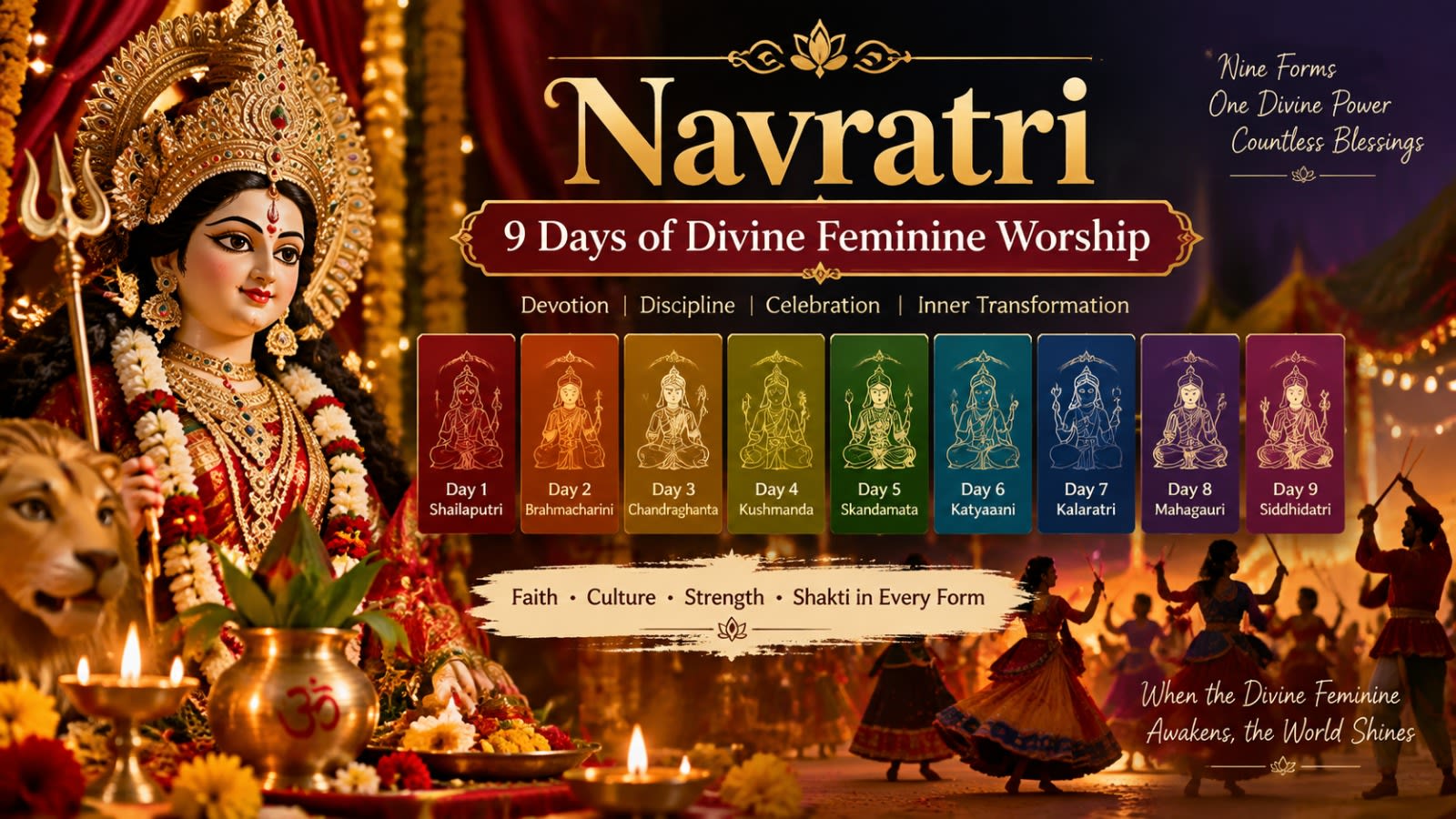
Navratri: 9 Days of Divine Feminine Worship
Navratri, meaning "nine nights," is one of the most widely celebrated Hindu festivals, honoring the nine forms (Navadurga) of Goddess Durga. Celebrated twice a year - Chaitra Navratri in spring (March-April) and Sharad Navratri in autumn (September-October) - the festival represents the triumph of divine feminine power (Shakti) over evil. Sharad Navratri, falling after the monsoons, is the more widely observed of the two and culminates in Vijayadashami (Dussehra).
Each of the nine nights is dedicated to a specific form of the Goddess, and each day has an associated color that devotees wear. Day 1 honors Shailputri (daughter of the mountains) - wear orange and offer jasmine flowers. Day 2 is for Brahmacharini (the ascetic goddess) - wear white and offer sugar. Day 3 celebrates Chandraghanta (the fierce protector) - wear royal blue and offer milk-based sweets. Day 4 honors Kushmanda (creator of the universe) - wear yellow and offer malpua. Day 5 is dedicated to Skandamata (mother of Kartikeya) - wear green and offer bananas. Day 6 celebrates Katyayani (the warrior goddess) - wear grey and offer honey. Day 7 honors Kalaratri (the destroyer of darkness) - wear purple and offer jaggery. Day 8 is Mahagauri (the radiant goddess) - wear peacock green and offer coconut. Day 9, Mahanavami, honors Siddhidatri (bestower of supernatural powers) - wear pink and offer sesame seeds.
The ritual framework of Navratri varies significantly by region. In Gujarat, the festival is famous for Garba and Dandiya Raas - energetic folk dances performed in circles around a central lamp or image of the Goddess, continuing late into the night. In West Bengal, it manifests as Durga Puja with massive artistic pandals (temporary structures) housing elaborate clay idols of Durga slaying the buffalo demon Mahishasura. In South India, Golu (or Bommai Kolu) is the tradition of arranging dolls and figurines on tiered steps, depicting scenes from mythology and daily life.
Fasting during Navratri follows specific rules: devotees avoid grains, onion, garlic, and non-vegetarian food for nine days. The Navratri-friendly diet includes kuttu ka atta (buckwheat flour), singhara atta (water chestnut flour), sabudana (tapioca), fruits, and dairy. On Ashtami (8th day) or Navami (9th day), many families perform Kanya Pujan - inviting nine young girls representing the nine forms of the Goddess, washing their feet, and offering them food and gifts. This beautiful tradition reinforces the sacredness of the feminine principle at the community level.