Understanding the Significance of Aarti
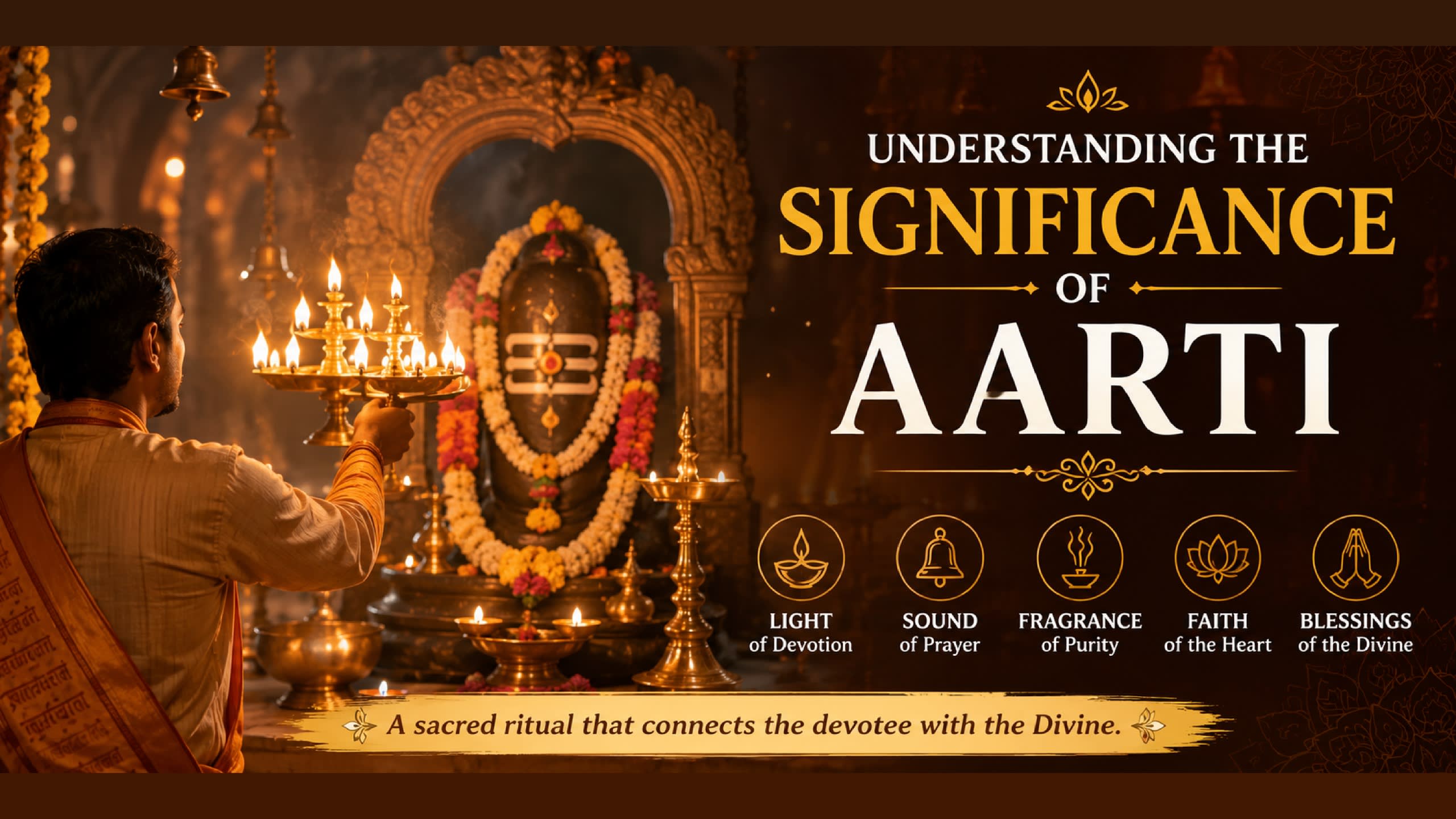
Aarti is one of the most recognisable and best-loved rituals in Hinduism, performed daily in temples, homes and sacred spaces across India. The word itself comes from the Sanskrit ārātrika, built from rātri, meaning night or darkness. An aarti is, quite literally, the lamp that removes darkness.
Almost every devotee has stood before a deity as a plate of flickering flame circles through the air, bells ring, and a familiar bhajan rises around them. Yet few people pause to ask why the ritual is built the way it is. Why five wicks? Why a clockwise circle? Why do we cup our hands over the flame afterward? This guide walks through the meaning, the symbolism and the practical reasoning behind each part of the aarti, along with the different types of aarti performed across major temples in India.
Key Highlights
- Aarti comes from the Sanskrit ārātrika, meaning something performed to dispel darkness
- The five-wick lamp, the panch-pradeep, represents the Pancha Mahabhuta, the five great elements of creation
- Waving the lamp offers the entire material universe back to its source, which is why aarti counts as a complete offering
- Every accompanying element, from the bell to the camphor, carries its own symbolic and sensory purpose
- Large temples perform aarti five times a day; most homes perform it twice, at sunrise and sunset
- The clockwise circular motion represents the cycle of creation and ensures every devotee gets a full darshan
- Camphor is preferred as fuel because it burns without residue, symbolising the ego dissolving completely
What Is Aarti? (Quick Answer)
Aarti is a Hindu ritual of devotion in which a lit lamp, usually holding one, five or more wicks soaked in ghee or oil, is waved in a circular motion before a deity, a sacred object or a respected guest. It is typically accompanied by the ringing of a bell, devotional songs, and the offering of incense, flowers and water.
The ritual marks the closing act of worship (puja) and is meant to honour the divine with light, sound and fragrance, while inviting that same divine energy back into the devotee's own life. If you want the practical method rather than the meaning, our step-by-step explainer on what aarti is and how to perform it covers the ritual itself.
The Origin and Meaning of the Word Aarti
The Sanskrit root ārātrika refers to something performed at night to dispel darkness, and over centuries the word softened into aarti, arti or arati depending on the region. In North India it is commonly spelled aarti; in parts of the South and West, arati or harati is more common, though the ritual itself remains largely the same.
Aarti is classically counted among the shodashopachara, the sixteen traditional steps of formal worship described in the Agama and Purana texts, where offering a lamp (deepa) to the deity is one of the closing and most important steps. Historically, temple worship followed the rhythm of a royal household: the deity is woken, bathed, dressed, fed and put to rest each day, and aarti marks several of these transitions with light and sound. The lamp at the centre of it all carries its own long tradition, explained in our guide on why we light a diya.
The Symbolism Behind the Aarti Lamp: Panch-Pradeep
The most common aarti lamp used in temples has five wicks and is called the panch-pradeep. The number five is not decorative. It represents the Pancha Mahabhuta, the five great elements that Hindu philosophy holds as the building blocks of all creation: earth, water, fire, air and ether (space).
When a priest or devotee lifts the panch-pradeep before the deity, the act symbolically offers the entire material universe back to its source. This is why aarti is considered a complete offering, even when no other items are presented.
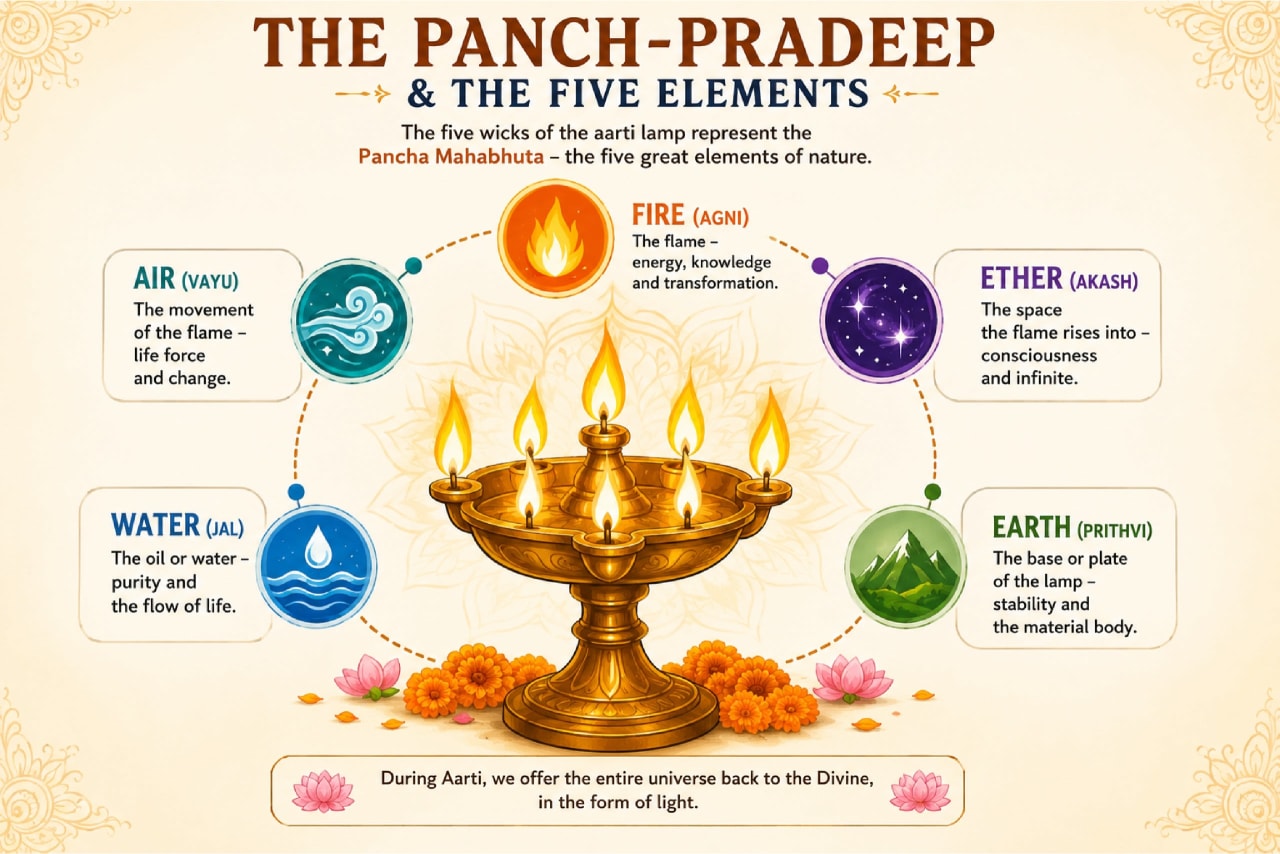
| Element | Sanskrit Name | Represented By | Symbolic Meaning |
|---|---|---|---|
| Earth | Prithvi | The base or plate of the lamp | Stability and the material body |
| Water | Jal | The oil or the kalash placed nearby | Purity and the flow of life |
| Fire | Agni | The flame itself | Knowledge, energy and transformation |
| Air | Vayu | The movement of the flame as it is waved | Breath, life force and change |
| Ether / Space | Akash | The open space the flame rises into | Consciousness and the infinite |
What Happens During an Aarti: Step by Step
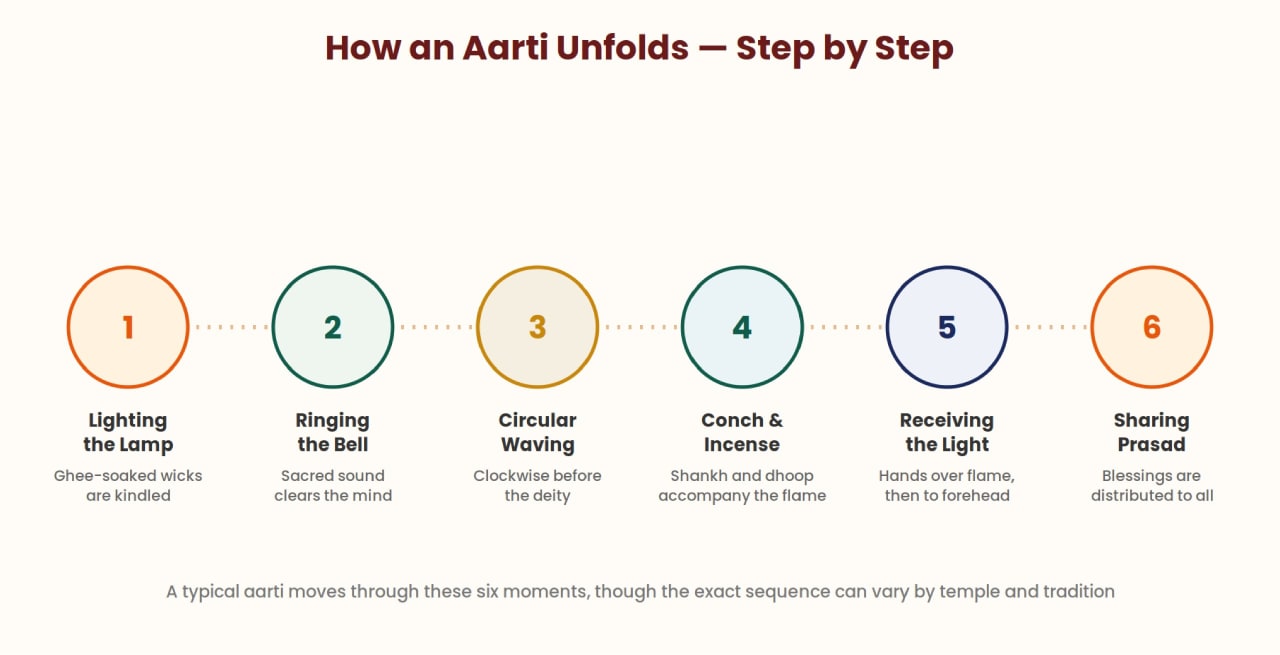
The exact sequence can vary slightly between temples, sampradayas and home traditions, but most aartis follow a familiar arc:
- Lighting the lamp: The wicks, soaked in ghee or oil, are lit just before the ritual begins.
- Ringing the bell: A bell is rung continuously through the ritual to focus the mind and mark the start of the offering.
- Circular waving: The lamp is moved in a clockwise circle before the deity, usually starting at the feet, moving to the face, and then encompassing the whole form.
- Conch and incense: In larger temples, the conch (shankh) is blown and incense (dhoop) is offered alongside the flame.
- Receiving the light: Devotees cup their hands briefly over the passing flame and touch their fingertips to their forehead, symbolically drawing the light inward.
- Sharing prasad: Once the aarti concludes, prasad, blessed food or sweets, is distributed among everyone present.
The food shared at the end is not an afterthought either. Our guide on prasad, the sacred offering of food explains why the distribution matters as much as the offering.
The Meaning Behind Each Element of the Ritual
Every accompanying element of an aarti has its own purpose, sensory as well as symbolic:
| Element | Sanskrit Name | Symbolic Meaning |
|---|---|---|
| Bell | Ghanta | Its sustained ring is believed to clear negative energy and pull the mind into the present moment before worship |
| Conch shell | Shankh | Blown to produce a sound associated with the primordial vibration Om, announcing the start of worship |
| Camphor | Karpoor | Burns completely without leaving residue, symbolising the ego dissolving entirely in the presence of the divine |
| Incense | Dhoop / Agarbatti | Represents the purification of the surrounding air and the spreading of a pleasant atmosphere in all directions |
| Flowers | Pushpa | Offered for their beauty and fragrance, standing for devotion that is freely and joyfully given |
| Water | Jal / Achamana | Often circled around the lamp or offered separately, representing purity and the sustaining of life |
Did you know? The conch's sound is traditionally linked to Om, the syllable Hindu thought treats as the origin of all vibration. You can read more in our guide to Om (Aum), the sound of the universe, and on the instrument that opens most aartis in our article on the sacred science behind temple bells.
Types of Aarti Performed in Temples
Large, actively worshipped temples do not perform aarti only once. Many follow a five-times-a-day schedule that mirrors a deity's daily routine, from waking in the morning to retiring at night. Smaller temples and most households typically perform aarti twice a day, at sunrise and at sunset.
| Aarti Name | Approximate Time | Occasion / Significance |
|---|---|---|
| Mangala Aarti | Pre-dawn, roughly 4:00–6:00 AM | The first aarti of the day, marking the deity's symbolic waking and the first darshan of the morning |
| Shringar Aarti | Early morning, after Mangala | Performed once the deity has been bathed and dressed, celebrating the adorned form |
| Rajbhog / Bhog Aarti | Midday | Follows the offering of the main midday meal to the deity; the prasad from this aarti is considered especially auspicious |
| Sandhya Aarti | Evening, around dusk | The most widely attended aarti, marking the deity's evening darshan as day turns to night |
| Shayan Aarti | Late night | The final aarti, performed before the deity symbolically retires for the night; many temples close shortly after |
Timings vary by temple, tradition and season, so devotees planning a visit around a specific aarti should always confirm the schedule with the temple trust before travelling.
Why Is the Flame Waved in a Circular Motion?
The circular path of the aarti lamp carries a double meaning. Symbolically, the circle represents the cyclical nature of creation: birth, growth, death and rebirth, with the deity at the still centre of that turning wheel. Practically, moving the flame in a slow circle ensures that light passes over the entire form of the deity rather than illuminating only one part, so every devotee present receives a full, unbroken view (darshan) of the divine image bathed in light.
The gesture of cupping the hands over the passing flame and touching the fingertips to the forehead extends the same idea to the individual. It is a symbolic act of drawing divine light inward, toward the ajna or third-eye point, associated in Hindu tradition with awareness and inner vision. That same point is where the tilak is applied, as explained in our article on the spiritual meaning of tilak and kumkum.
The Practical Reasoning Behind the Ritual
Beyond symbolism, aarti has a grounding, practical function that has helped it survive largely unchanged for centuries. The ringing bell and rhythmic chanting give the mind a single point of focus, which is one reason group aarti often feels calming even to first-time visitors.
Camphor is favoured as fuel precisely because it leaves no soot or residue on temple walls and idols, unlike many other combustible materials. And because aarti is almost always a shared, standing ritual, it naturally draws a scattered group of devotees into one synchronised moment, which is part of why it has remained central to community worship.
For a broader look at the reasoning behind Hindu rituals, see our detailed guide on the science behind Hindu rituals, and our companion piece on the meaning behind temple bells, lamps and incense.
Best Time to Perform Aarti at Home
For home worship, the two most widely followed times are sunrise and sunset, the natural transition points of the day. A brief aarti at these times is considered enough for most households; there is no requirement to match a temple's five-times-a-day schedule.
- Morning aarti: performed after the morning bath, as part of the first prayers of the day.
- Evening aarti: performed around dusk, often marking the close of the day's work and the start of family time.
For the complete method, including samagri and step-by-step instructions for daily worship at home, see our guide on how to do daily puja at home. Aarti also closes larger ceremonies such as a Rudrabhishek Puja or a Satyanarayan Puja at home, where the same lamp is waved after the main offerings are complete.
Popular Aarti Songs and Regional Variations
Different deities and regions have their own well-loved aarti songs, sung to accompany the waving of the lamp. Om Jai Jagdish Hare is perhaps the most widely sung aarti across North India, offered to Vishnu and his forms. Aarti Kunj Bihari Ki is dedicated to Krishna, while Jai Ganesh Deva is one of the most common openings to any puja, sung to Ganesha before other deities are worshipped.
You can read the lyrics and meaning of these across deities in our complete aarti collection guide, or set up a calmer evening routine with our selection of evening prayers and mantras.
Editor's note: Aarti customs vary across regions, sampradayas and individual family traditions. This article covers commonly followed practices. For rituals specific to your family tradition or a particular temple, please consult a local priest or your family's spiritual guide.
Frequently Asked Questions
What does the word aarti mean? Aarti comes from the Sanskrit aratrika, meaning something performed at night to remove darkness. It refers to the ritual of waving a lit lamp before a deity.
Why is aarti performed in a circular motion? The circular motion represents the cyclical nature of creation and ensures the light passes over the entire form of the deity, giving every devotee present a complete darshan.
Why do we touch our hands to our forehead after aarti? Cupping the hands over the flame and touching the forehead is a symbolic gesture of drawing the divine light inward, toward the point of awareness and inner vision.
How many times a day is aarti performed in temples? Large, actively worshipped temples typically perform aarti five times a day: Mangala, Shringar, Rajbhog, Sandhya and Shayan. Smaller temples and most homes perform it twice daily, at sunrise and sunset.
Why is camphor used in aarti instead of other materials? Camphor burns completely and leaves no residue, which symbolises the ego dissolving in the presence of the divine and also keeps idols and temple walls free of soot.
What is the difference between aarti and puja? Puja refers to the full act of worship, which can include bathing the deity and offering food, flowers and chanting. Aarti is one specific step within puja, usually performed toward the end, involving the waving of a lit lamp.
What is the correct direction to move the aarti lamp? The lamp is moved clockwise, mirroring the traditional direction of circumambulation (parikrama) around a deity or sacred structure.
Do I need a five-wick lamp to perform aarti at home? No. A single-wick diya is perfectly acceptable for daily home worship. The panch-pradeep is common in temples, but the intention behind the offering matters more than the number of wicks.
Conclusion
Aarti endures because it works on more than one level at once. It is a piece of philosophy compressed into five burning wicks, a moment of shared focus for an entire room of devotees, and a simple, repeatable act that families can carry from one generation to the next. Understanding what each part represents does not make the ritual less mysterious, but it does make it easier to stand before the flame with full attention rather than habit.
If you would like a verified pandit to guide your family through a complete puja, including aarti, from anywhere in the world, you can arrange one through DevMarg. For more on the meaning behind everyday worship, explore the full DevMarg blogs hub.