
Papankusha Ekadashi Vrat Katha: The Complete Story
The month of Ashwin is cooling into autumn, Navratri has just closed, and the bright fortnight is at its peak. On its eleventh day comes Papankusha Ekadashi, one of the most forgiving fasts in the Hindu year. The name itself carries the promise: papa means sin, ankusha means a goad or hook, so this is the ekadashi that hooks and pulls sin away.
This guide narrates the complete Papankusha Ekadashi Vrat Katha, the traditional story Lord Krishna told Yudhishthira about a cruel hunter who escaped hell. You will also find who told the tale, what each part of it means for first-time vratis, how the fast is kept, and the simple rules that go with it.
Key facts
- Fortnight
- Ashwin Shukla Paksha (bright half)
- Tithi
- Ekadashi (eleventh day)
- Presiding deity
- Lord Vishnu (Padmanabha)
- Scriptural source
- Brahmavaivarta Purana
- Benefit
- Release from accumulated sins
What is the Papankusha Ekadashi vrat katha?
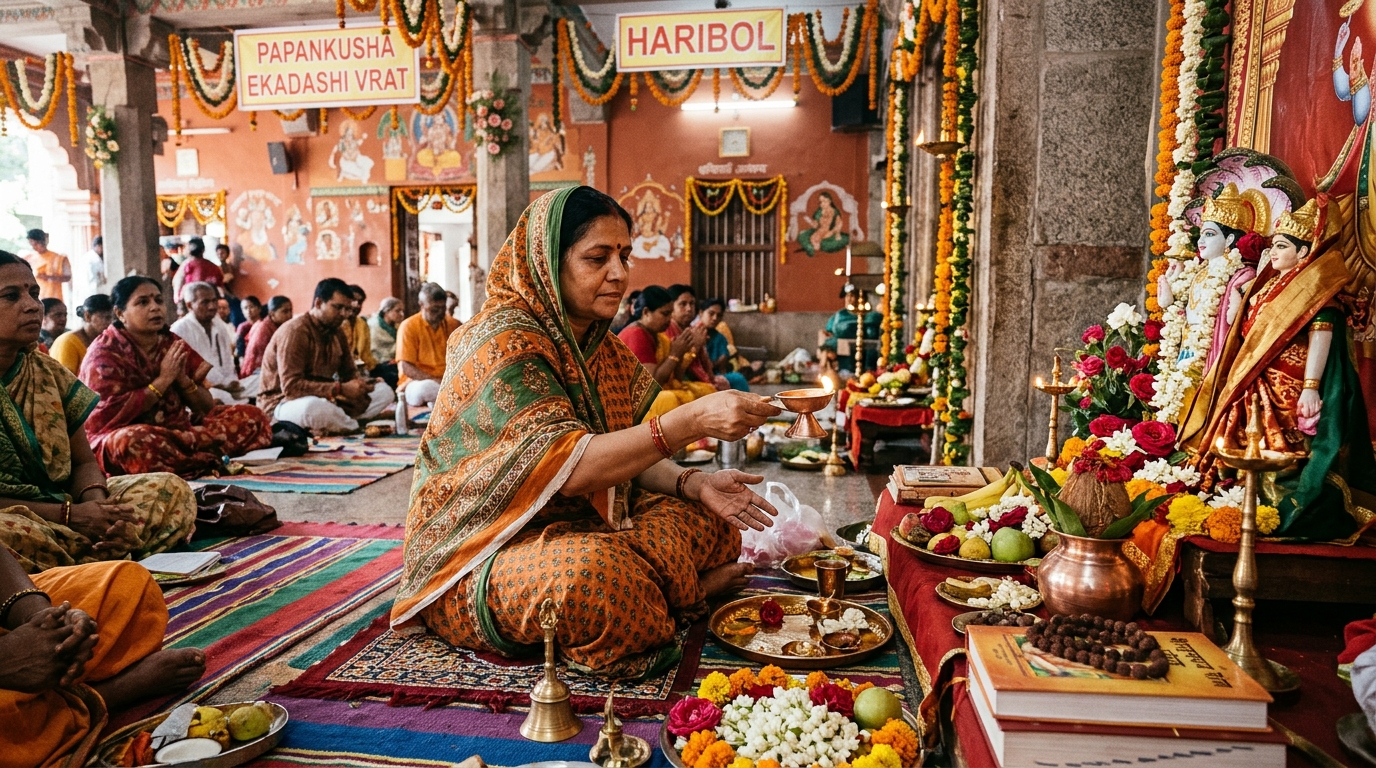
The Papankusha Ekadashi vrat katha is the story of Krodhana, a cruel and violent hunter who lived a life full of sin yet was saved from hell by observing this single fast on his deathbed. On the advice of the sage Angira, he kept the vrat with faith, and Lord Vishnu's grace carried him to Vaikuntha instead of Yama's domain. Krishna narrated this story to Yudhishthira to explain what the Ashwin Shukla Ekadashi accomplishes.
The tale is recorded in the Brahmavaivarta Purana and is read aloud by families keeping the fast. It belongs to the wider family of Ekadashi observances, twenty-four in a normal year and twenty-six in a year with an extra lunar month.
Who narrated this story, and to whom?
The katha comes to us through a conversation between Lord Krishna and Yudhishthira, the eldest Pandava. Yudhishthira asks Krishna about the ekadashi that falls in the bright fortnight of Ashwin, its name, its presiding deity, and the fruit it grants.
Krishna answers that this day is called Papankusha Ekadashi, that its lord is Padmanabha, a form of Vishnu, and that even a slight observance of it destroys sins gathered over many lifetimes. To prove the point, he tells the story of the hunter. This framing matters: the katha is not folklore passed between villages but a teaching placed in the mouth of Krishna himself, which is why reciting it is treated as part of the worship.
The story of Krodhana the hunter
Long ago, in the forests near the Vindhya mountains, lived a hunter named Krodhana. His name means the angry one, and he earned it. He killed animals without mercy, stole, lied, drank, and gave no thought to gods, guests, or the dead. Through his whole life he never once gave in charity or spoke a kind word.
Then old age came, and with it the fear of death. As his final day drew near, Yama, the lord of death, instructed his messengers to bring Krodhana's soul. The hunter saw them approaching, terrible and dark, and understood at last where his life had led. Shaking with terror, he ran.
1
A single ekadashi fast was enough to undo a lifetime of the hunter's sins.
Krodhana finds the sage Angira
In his panic Krodhana fled deep into the forest and came upon the hermitage of the sage Angira, a rishi whose austerity had made him radiant. The hunter fell at his feet and begged for a way out. He confessed without reservation that he had spent every year in cruelty and had no good deed to his name, and he asked whether anything at all could save a man like him.
Angira did not turn him away. He saw that the hunter's fear was real and his surrender complete. A sincere plea, the sages held, is itself the beginning of merit.
The sage's instruction
The sage told Krodhana that the eleventh day of the bright fortnight of Ashwin was close, and that this day was Papankusha Ekadashi, beloved of Vishnu. He instructed the hunter to keep a complete fast on that day, to stay awake through the night in the Lord's remembrance, and to worship Padmanabha with a true heart.
Krodhana obeyed exactly. He fasted, he kept the night vigil, and for the first time in his life he turned his mind to God rather than to the hunt. When his death finally came, Yama's messengers reached for his soul, but the attendants of Vishnu arrived first. They told Yama's men to withdraw, for this man had kept Papankusha Ekadashi, and no servant of death could touch him. Krodhana was carried to Vaikuntha, the abode of Vishnu, released from every sin.
What the katha teaches first-time vratis
The story answers a worry that many first-timers carry quietly: whether a fast can really matter after years of neglecting worship. Krodhana had no prior merit, no temple habit, no charity behind him. One fast, kept with full faith on the right day, was enough.
The lesson is not that sin carries no weight. It is that sincere surrender at the feet of Vishnu, expressed through a disciplined fast, is accepted. Three things in the tale do the work: the hunter's honest confession, his exact obedience to the sage, and the night vigil that turned his attention to God.
Tip: If you are keeping this fast for the first time, read the katha aloud during your evening puja rather than silently. Reciting it is considered part of the observance, not an optional extra.
How the Papankusha Ekadashi vrat is kept
- The fast runs from sunrise on Ekadashi to the parana, the breaking of the fast, on the morning of Dwadashi, the twelfth day. Families in Delhi and across North India follow a simple sequence. The timings below are indicative; confirm the exact Ekadashi tithi and parana window for your city, since the tithi can begin and end at different clock times each year.
| Stage | When | What you do |
|---|---|---|
| Sankalp | Ekadashi morning | Take a vow to fast and bathe early |
| Puja | Ekadashi day | Worship Vishnu as Padmanabha with tulsi, flowers, and a lamp |
| Katha | Ekadashi evening | Read or hear the vrat katha |
| Jagran | Ekadashi night | Stay awake in bhajan and the Lord's name |
| Parana | Dwadashi morning | Break the fast within the prescribed window |
The nirjala form, without even water, is the strictest. Many keep a phalahar fast instead, taking fruit, milk, and non-grain foods. Grains, rice, beans, onion, and garlic are avoided through the day.
Watch out: Do not break the fast before the parana window opens on Dwadashi, and do not let it stretch past Dwadashi tithi. Breaking at the wrong time is held to reduce the fruit of the vrat. Check the day's panchang for your location.
Why Vishnu is worshipped as Padmanabha
On Papankusha Ekadashi the Lord is invoked as Padmanabha, the one from whose navel a lotus rises bearing Brahma the creator. The name sets the mood of the day. While some ekadashis stress a particular boon, this one stresses creation renewed and sin wiped clean, a fresh start granted to one who asks for it.
For your worship you need little. A clean image or picture of Vishnu, tulsi leaves, yellow flowers, incense, a ghee lamp, and a naivedya of fruit are enough. Offering tulsi is considered especially dear to Vishnu, so most families keep a few fresh leaves ready.
Where this ekadashi sits in the vrat calendar
Papankusha Ekadashi falls soon after Navratri closes, in the same bright autumn fortnight. It is one of two ekadashis each lunar month, paired with the dark-fortnight ekadashi that comes a fortnight later. If you are building a year of observances, it fits naturally alongside the Pradosh Vrat kept on the thirteenth tithi and the Purnima Vrat of the full moon.
Say you plan to keep every ekadashi through the year as a first-time vrati. You would mark Papankusha Ekadashi in Ashwin, then the dark-fortnight ekadashi that follows, and continue month by month. The full Vrat Upavas calendar lists each tithi with its city timings, so you can see which dates the fast lands on in the 2026 and 2027 years without guessing.
A short recap before you fast
The Papankusha Ekadashi Vrat Katha narrates how the hunter Krodhana, steeped in a lifetime of cruelty, was saved by a single fast kept on the advice of sage Angira and carried to Vaikuntha. Krishna told the tale to Yudhishthira to show that sincere surrender to Vishnu, through fasting, night vigil, and the reading of this very story, outweighs past sin.
To keep the fast well, take your sankalp at sunrise, worship Vishnu as Padmanabha, read the katha in the evening, keep the night vigil, and break the fast within the Dwadashi parana window for your city. For the surrounding observances, see the related Devmarg guides on Ekadashi and the wider Vrat Upavas section, and check your dates on the yearly calendar.
Frequently asked questions
Is the Papankusha Ekadashi katha in the Padma Purana or the Brahmavaivarta Purana?
The story is most commonly cited from the Brahmavaivarta Purana, told as a dialogue between Lord Krishna and Yudhishthira. Several ekadashi mahatmya texts repeat it, and you may see it attributed to the Padma Purana in some collections. The narrative itself, of Krodhana the hunter saved by sage Angira's advice, stays the same across these sources.
Do I have to read the vrat katha aloud, or is listening enough?
Either is accepted. Traditionally one person reads the katha aloud during the evening puja while the family listens, since hearing the story is itself counted as part of the observance. If you are fasting alone, reading it aloud to yourself is fine. The point is attentive remembrance, not the exact form of recitation.
Can I keep this fast with only water instead of a full nirjala vrat?
Yes. The nirjala form, without even water, is the strictest, but many keep a phalahar fast with fruit, milk, and non-grain foods. People who are elderly, unwell, pregnant, or on medication usually take water and fruit rather than a waterless fast. Choose the form you can keep with steadiness through the day and night.
What foods are not allowed during the Papankusha Ekadashi vrat?
Grains such as rice and wheat, pulses and beans, onion, and garlic are avoided on all ekadashis, including this one. Those on a phalahar fast take fruit, milk, curd, nuts, and sendha namak only. Honey, meat, and alcohol are kept out entirely. The restriction runs from sunrise on Ekadashi to the parana on Dwadashi morning.
Why did a lifelong sinner like Krodhana reach Vaikuntha from just one fast?
The katha stresses that his fear was genuine, his confession complete, and his obedience to the sage exact. He hid none of his sins and turned fully to Vishnu during the night vigil. The teaching is that sincere surrender, not mere ritual, is accepted. It does not say sin is weightless, only that honest devotion to the Lord outweighs it.
When do I break the Papankusha Ekadashi fast?
Break the fast on Dwadashi, the twelfth day, within the parana window that follows sunrise. Do not break it before the window opens and do not let it run past the end of Dwadashi tithi. The exact clock time changes each year and by city, so check the day's panchang for your location before you break the fast.
Is Papankusha Ekadashi the same as Indira Ekadashi?
No. Indira Ekadashi falls in the dark fortnight of Ashwin, about a fortnight earlier, and its katha is about offering relief to ancestors. Papankusha Ekadashi falls in the bright fortnight of the same month and centres on release from one's own accumulated sins. They are two different ekadashis within the single month of Ashwin.
Can women keep this fast during menstruation?
Practice varies by family and tradition. Many women pause formal fasting and puja during menstruation and resume afterwards, while others keep a simple mental remembrance of Vishnu without the full ritual. There is no single rule. Follow what your family elders observe, and do not strain yourself; the katha values sincere faith over rigid performance.